


Invisalign Vs Braces: Which Option Fits Your Smile, Age And Lifestyle?
Invisalign and braces can both straighten teeth, improve the bite, and create a healthier smile. The best option depends on the complexity of your case, your age, daily habits, and how discreet you want treatment to be.
At American Dental Hospital, each patient receives an individual orthodontic assessment before a treatment is recommended.
Invisalign Vs Braces: The Main Difference
The main difference between Invisalign and braces is how they move the teeth.
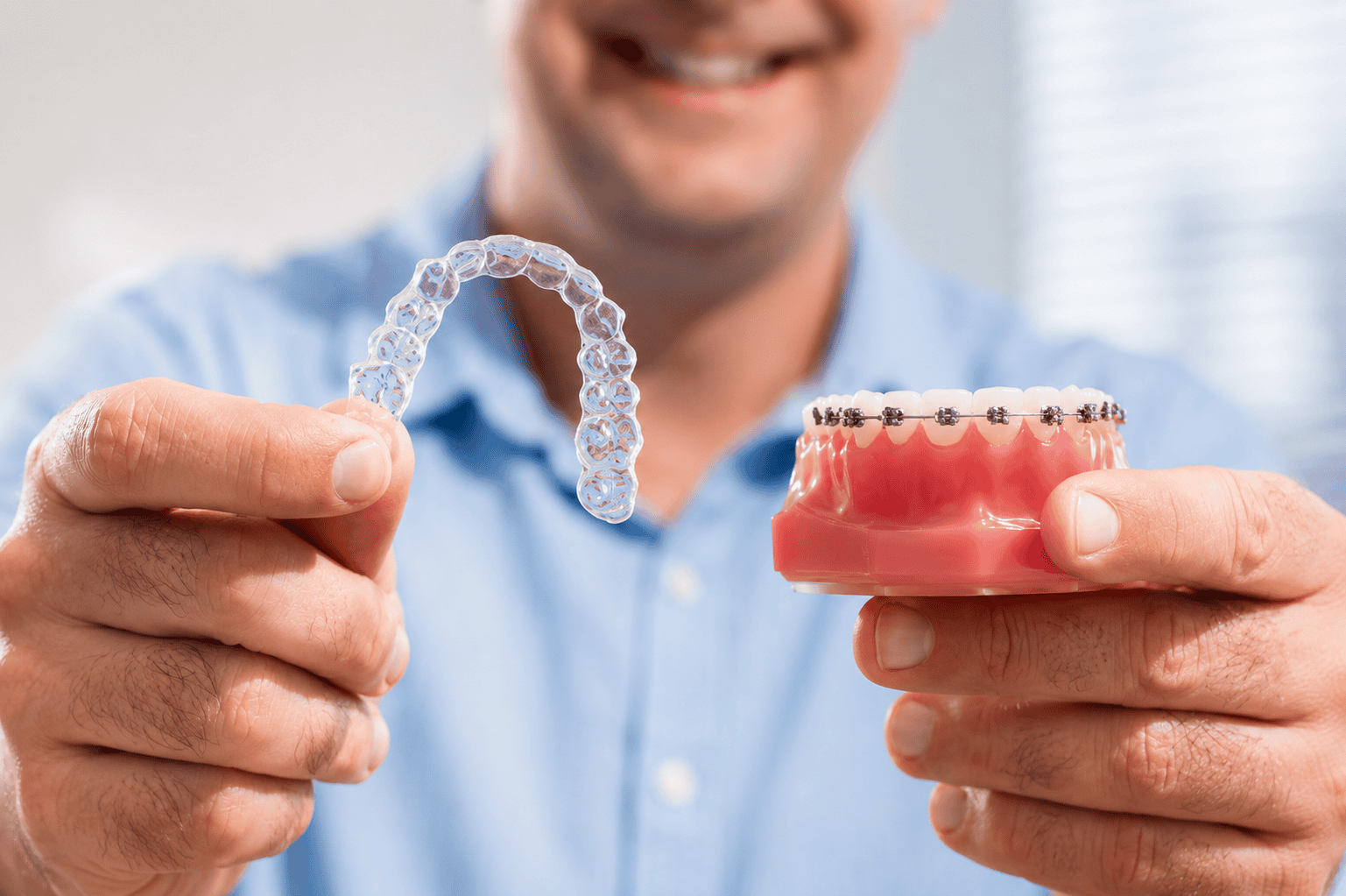
Traditional braces use brackets attached to the teeth and an orthodontic wire that applies continuous pressure. The system remains fixed throughout treatment and is adjusted regularly by the orthodontist.
Invisalign uses a series of transparent, removable aligners. Each set is custom-made and gradually moves the teeth according to a digitally planned sequence. American Dental Hospital uses digital imaging and orthodontic evaluation to determine whether clear aligners are suitable for the patient’s teeth and bite.
Neither option is automatically better for everyone. The right choice depends on what needs to be corrected and how well the patient can follow the treatment instructions.
Invisalign Vs Braces Comparison Table
| Comparison Factor | Invisalign | Traditional Braces |
| Appearance | Clear and nearly invisible | Metal brackets and wires are visible |
| Removability | Removable for meals and cleaning | Fixed to the teeth |
| Daily discipline | Must be worn consistently as instructed | Works continuously without removal |
| Food restrictions | Aligners are removed before eating | Hard, sticky, and chewy foods may need to be avoided |
| Cleaning | Teeth can be brushed normally after removing aligners | Extra care is needed around brackets and wires |
| Comfort | Smooth aligners with no metal brackets | Temporary irritation may occur around brackets and wires |
| Complex cases | Suitable for many mild and moderate cases and selected complex cases | Often preferred for highly complex movement or bite correction |
| Appointments | Progress checks and new aligner stages | Regular wire adjustments |
| Lifestyle | Popular with adults, professionals, and image-conscious patients | Suitable for children, teenagers, and adults |
| Responsibility | Success depends heavily on wearing the aligners correctly | Less dependent on patient compliance |
| Visibility | Very discreet | Clear or lingual brace alternatives may reduce visibility |
| Treatment planning | Digital sequence of custom aligners | Controlled movement through brackets and wires |
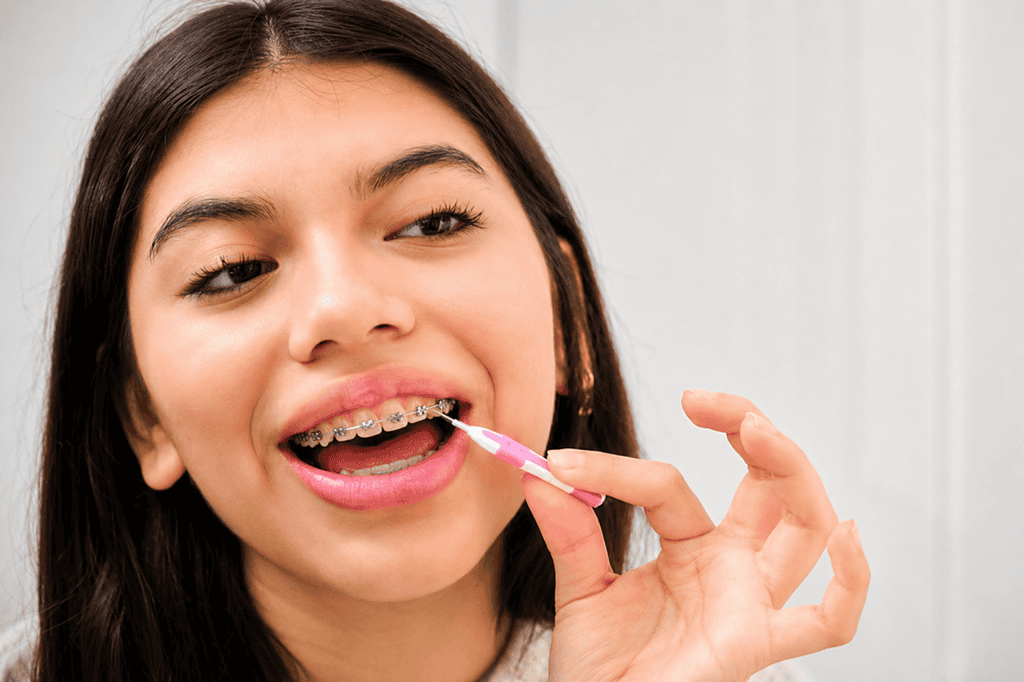
How Invisalign Works
Invisalign treatment begins with an orthodontic evaluation, digital images, and an assessment of the bite. A series of clear aligners is then created to guide the teeth through planned movements.
Each aligner is worn for a specific period before the patient moves to the next one. American Dental Hospital explains that Invisalign aligners are custom-made and designed to apply controlled pressure to gradually reposition the teeth.
The aligners are removable, but they must be worn consistently. Removing them too often can slow progress and affect the final result.
Invisalign may be used to correct problems such as:
- Mild or moderate crowding
- Spaces between teeth
- Certain overbites
- Selected underbites
- Some crossbites
- Teeth that have moved after previous orthodontic treatment
More complex cases may also be treatable with aligners, but the decision depends on tooth position, jaw relationships, and the experience of the orthodontic team.
How Traditional Braces Work
Traditional braces use brackets that are bonded to the front of the teeth. An orthodontic wire connects the brackets and applies continuous, controlled force.
During follow-up appointments, the orthodontist adjusts the wire or other components to guide the teeth into healthier positions.
Braces can correct crowding, spacing, overbites, underbites, crossbites, and several other alignment problems. American Dental Hospital describes braces as an effective fixed option for improving both tooth position and bite function.
Because braces remain attached to the teeth, they continue working throughout the day. Patients do not need to remember to put them back in after meals.
Which Option Looks More Discreet?
Invisalign is usually the more discreet option. The aligners are transparent and designed to fit closely over the teeth.
This makes them popular with adults, university students, professionals, and patients who do not want their orthodontic treatment to be obvious in photographs or social situations.
However, Invisalign is not the only discreet orthodontic choice.
American Dental Hospital also offers clear braces with tooth-coloured or transparent brackets. These provide the continuous action of fixed braces while appearing less noticeable than traditional metal brackets.
Lingual braces are another option. They are attached to the inside surface of the teeth, making them hidden from the front.
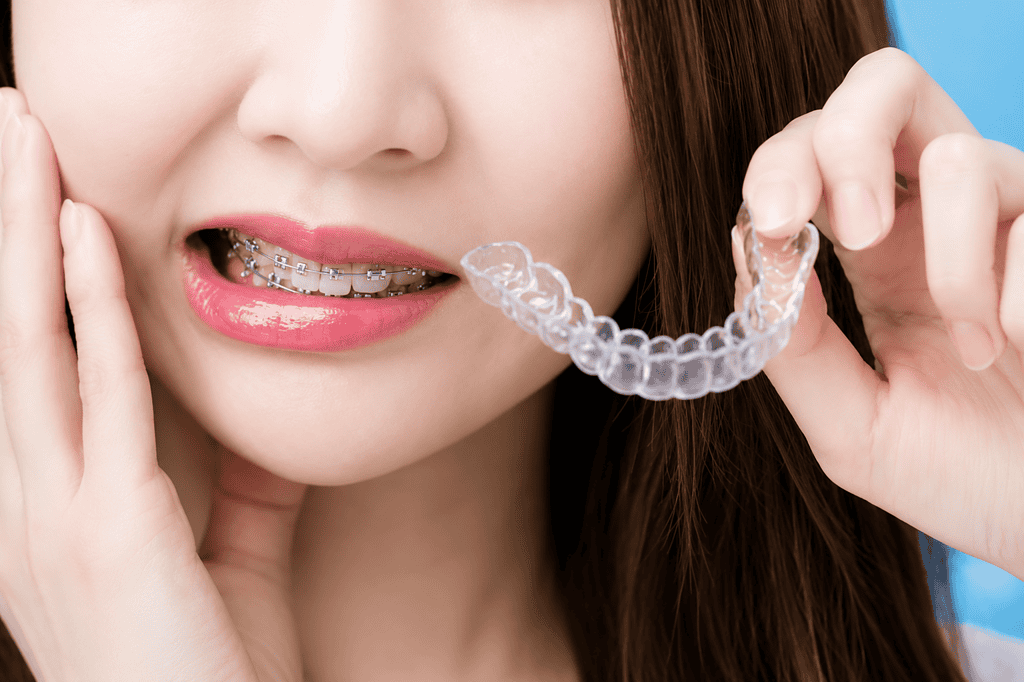
Which Option Is Better For Children?
Traditional braces are often a practical choice for children because they remain fixed and do not depend on the child remembering to wear removable aligners.
Children may forget to replace aligners after eating, lose them, or remove them too frequently. This can interrupt the planned tooth movement.
Braces can also give the orthodontist strong control over complex tooth movements and bite development.
However, some older children and teenagers may be responsible enough for clear aligner treatment. The decision should consider dental development, maturity, oral hygiene, and the type of correction required.
American Dental Hospital provides pediatric and adult orthodontic care, allowing the treatment plan to be adapted to the patient’s age and stage of development.
Which Option Is Better For Adults?
Many adults prefer Invisalign because the aligners are discreet and can be removed for meetings, meals, photographs, and important social events.
They may also make oral hygiene easier because patients can brush and floss without brackets or wires in the way.
However, adult patients are not limited to Invisalign. Traditional braces, clear braces, and lingual braces can all be effective depending on the case.
Adults with complex bite problems may benefit from a fixed system because it provides continuous control. Patients with major skeletal jaw differences may need orthodontic treatment combined with orthognathic surgery rather than aligners alone. American Dental Hospital coordinates orthodontics with surgical treatment for selected complex jaw cases.
Eating With Invisalign
Invisalign aligners are removed before eating. This means patients can generally continue enjoying their usual foods.
The teeth should be cleaned before the aligners are placed back in the mouth. Food trapped beneath an aligner can increase the risk of plaque, staining, and decay.
Patients should also avoid drinking sugary or strongly coloured beverages while wearing the aligners. Water is usually the safest drink when they are in place.
The freedom to remove aligners during meals is a major advantage, but it also requires consistent hygiene.
Eating With Braces
Braces remain attached while the patient eats. Certain foods may damage brackets or bend the orthodontic wire.
Patients are often advised to avoid very hard, sticky, or chewy foods. Food may also need to be cut into smaller pieces to reduce pressure on the appliance.
Examples of foods that may require care include:
- Hard sweets
- Sticky chewing gum
- Very hard nuts
- Crunchy foods bitten directly with the front teeth
- Chewy sweets
- Ice
Most patients adapt quickly. The orthodontic team can provide practical instructions based on the type of braces used.
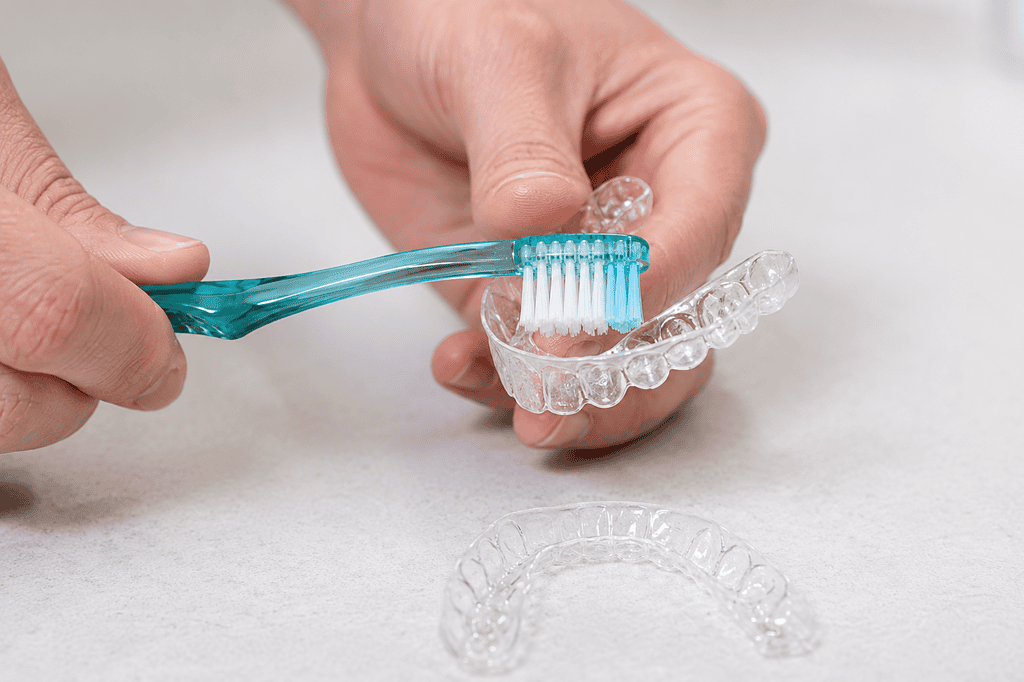
Oral Hygiene With Invisalign
Invisalign can make brushing and flossing more straightforward because the aligners are removed.
Patients can clean their teeth using their normal technique and then clean the aligners separately. However, good hygiene remains essential because the aligners sit closely over the teeth.
Putting aligners back over unclean teeth may trap plaque and food particles.
The aligners should also be cleaned according to the instructions provided by the orthodontic team. Hot water should generally be avoided because it may affect the shape of the material.
Oral Hygiene With Braces
Cleaning around fixed braces requires more time and attention.
Plaque can collect around brackets and underneath wires. Without proper cleaning, this may contribute to gum inflammation, decay, or visible marks on the enamel.
Patients may need an orthodontic toothbrush, interdental brushes, floss threaders, or a water flosser.
Good oral hygiene is not a minor part of braces treatment. It helps protect the teeth while they are being moved.
Regular professional cleaning may also be recommended during longer orthodontic treatment.
Which Option Works Better For Complex Cases?
Traditional braces may be preferred for severe crowding, major rotations, difficult tooth movements, impacted teeth, or complex bite correction.
Because the appliance is fixed, the orthodontist can use different wires, attachments, elastics, and controlled forces throughout treatment.
Invisalign technology has developed significantly and can now treat a wider range of cases. However, it is not always the most suitable choice.
A patient may be attracted to clear aligners, but the orthodontist may recommend braces if they provide more control or a more dependable result.
American Dental Hospital offers traditional braces, clear braces, lingual braces, Invisalign, and coordination for orthognathic cases. This allows the orthodontic team to compare several options rather than directing every patient toward one system.
How Long Does Treatment Take?
Treatment time depends more on the complexity of the case than on the name of the appliance.
Mild spacing or crowding may be corrected faster than a severe bite problem. Missed appointments, broken braces, poor aligner use, or inadequate hygiene can also delay progress.
American Dental Hospital notes that clear braces commonly require around 12 to 24 months, although simple or highly complex cases may fall outside that range.
Invisalign treatment time varies according to the number of aligners and the movements required.
Patients should be cautious about choosing an option only because it is advertised as faster. The goal is stable, healthy alignment rather than rushed tooth movement.
Why Choose American Dental Hospital For Orthodontic Treatment?
American Dental Hospital offers several orthodontic systems in one private hospital environment. Patients can be evaluated for Invisalign, traditional braces, clear braces, lingual braces, pediatric orthodontics, adult treatment, and complex jaw correction.
What patients can expect:
- An individual orthodontic consultation
- Evaluation of tooth alignment and bite
- Digital X-rays and imaging when required
- Invisalign and several fixed-brace options
- Treatment for children, teenagers, and adults
- Coordination with oral and maxillofacial specialists for complex cases
- A retention plan to protect the final result
- Multilingual support for international patients
The hospital’s multidisciplinary setting means that gum health, restorative needs, jaw problems, and other dental concerns can be considered before orthodontic treatment begins. Its team includes expertise across orthodontics, oral surgery, cosmetic dentistry, and other dental fields.
Frequently Asked Questions
Is Invisalign Better Than Braces?
Invisalign is more discreet and removable, while braces provide continuous fixed treatment and may offer stronger control in complex cases. The better option depends on your teeth, bite, age, and habits.
Can Teenagers Use Invisalign?
Yes, responsible teenagers may be suitable for Invisalign. They must be able to wear the aligners consistently, clean them correctly, and avoid losing them.
Are Braces Only For Children?
No. Adults can receive traditional braces, clear braces, or lingual braces. Age does not prevent orthodontic treatment when the teeth and gums are healthy.
Can Invisalign Correct Bite Problems?
Invisalign can correct several bite problems, but not every case is suitable. Complex jaw or tooth movement may require braces or combined orthodontic and surgical treatment.
Are Clear Braces As Effective As Metal Braces?
Clear braces use a fixed bracket-and-wire system and can provide effective correction. American Dental Hospital states that they generally work at a similar rate to traditional braces, although suitability depends on the case.
Do I Need A Retainer After Invisalign?
Yes. Retainers are necessary after both Invisalign and braces because teeth can move after active treatment.
How Do I Know Which Option Is Right For Me?
The orthodontist must examine your teeth, gums, bite, and jaw relationship. Digital records and X-rays may also be needed before a recommendation can be made.
Contact American Dental Hospital
Ready to straighten your smile but unsure whether Invisalign or braces are right for you?
At American Dental Hospital, orthodontic treatment begins with a complete evaluation. Our team compares your alignment, bite, age, lifestyle, and personal goals before recommending the most suitable option.
Contact us for:
- Invisalign evaluation
- Traditional braces
- Clear ceramic braces
- Lingual braces
- Pediatric orthodontics
- Adult orthodontic treatment
- Complex bite assessment
- Personalised treatment planning
📍 American Dental Hospital
Rruga Sabaudin Gabrani Nr. 2, Tirana, Albania
📞 Phone and WhatsApp: +355 68 808 0805
📧 Email: [email protected]
Choose American Dental Hospital for modern orthodontic options, specialist guidance, and a treatment plan designed around your smile and lifestyle.
Get Your Free Dental Quote
Speak with an experienced dentist in Albania and receive a personalized treatment recommendation. We offer free evaluations for all dental treatments, with transparent pricing and expert guidance at every step.
Start your transformation today!
Send your details for a FREE CONSULTATION!
Get Your Free Dental Quote
Speak with an experienced dentist in Albania and receive a personalized treatment recommendation. We offer free evaluations for all dental treatments, with transparent pricing and expert guidance at every step.
Start your transformation today!
Send your details for a FREE CONSULTATION!
Blogs & Articles
Latest Articles
Get expert dental care tips and clinic updates—all designed to keep your smile healthy and bright.
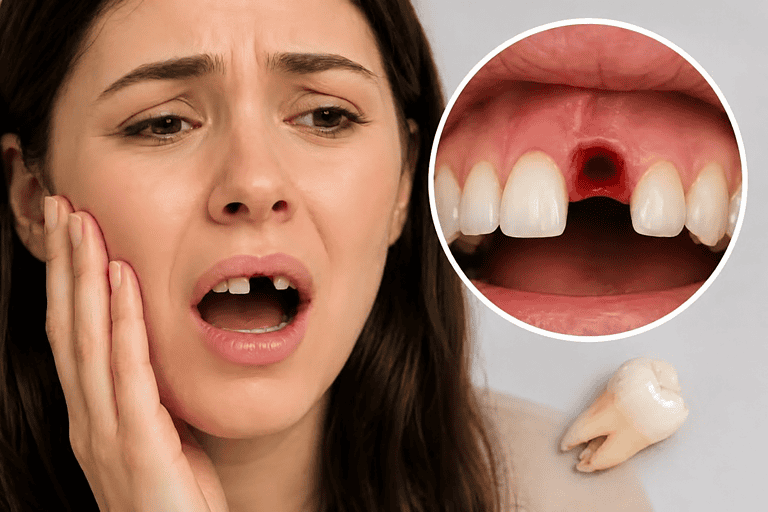
Knocked-Out Adult Tooth: Why Fast Dental Care Matters
A knocked-out adult tooth is a dental emergency, and acting quickly may help save it.
Read More
Baby Tooth Cavities: Why They Still Need Treatment
Baby tooth cavities might seem less important because those teeth will eventually fall out. However,
Read More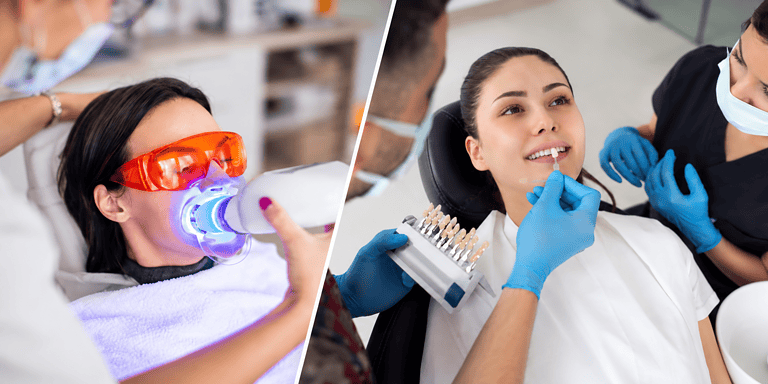
Teeth Whitening vs Veneers: Which Treats Stained Teeth?
Not all tooth stains need the same treatment. Teeth whitening can lighten natural teeth, while
Read More
Simple 1 minute consultation request for our experts
Request Your Free Quote
Start your transformation today!
Send your details for a FREE CONSULTATION!