


White Spots After Braces: 7 Best Tips for ICON vs Teeth Whitening in Albania
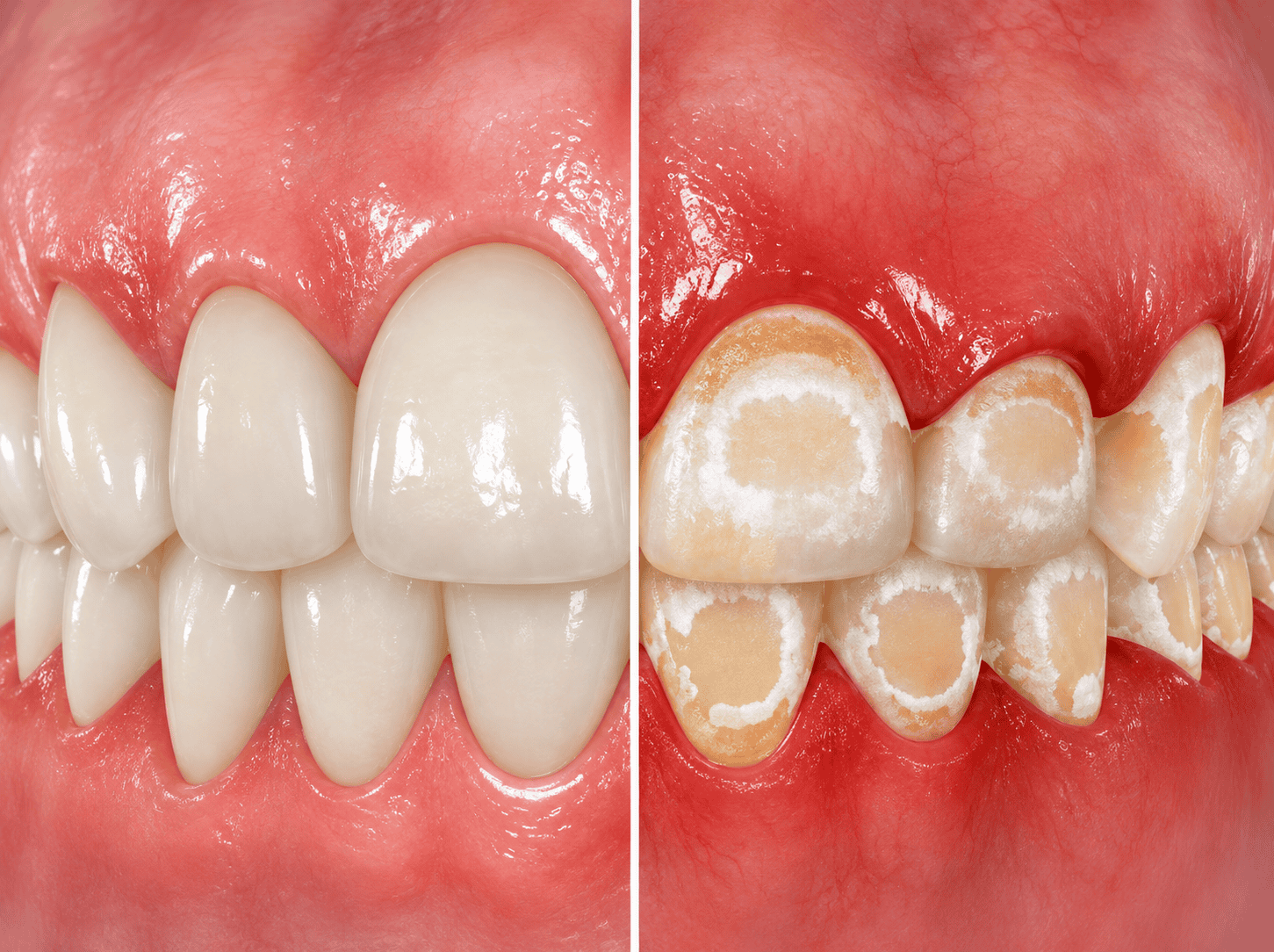
White spots after braces can remain visible once orthodontic brackets are removed, even when the rest of your smile looks healthy. These pale enamel patches can affect how evenly your teeth reflect light, making certain areas appear brighter or chalkier than the surrounding enamel.
At American Dental Hospital, we assess the cause of each enamel mark before comparing ICON treatment with professional teeth whitening in Albania. Understanding why white spots develop is essential for choosing a suitable treatment and preserving natural tooth structure.
If you are concerned about white spots after braces, these seven practical tips explain how ICON treatment and professional whitening differ, what each procedure can achieve, and when another dental approach may be necessary.
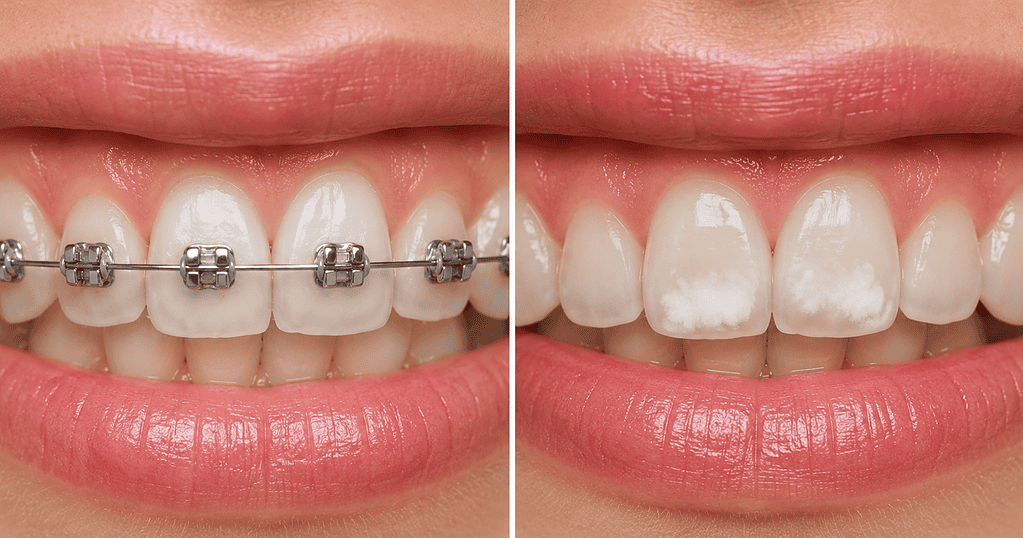
Why Do White Spots Appear on Teeth, Especially After Braces?
The outer enamel layer normally reflects light in a relatively consistent way. When its mineral structure changes, certain areas scatter light differently and appear chalky, cloudy, or noticeably whiter than the surrounding surface.
Several situations may contribute to this appearance:
- After orthodontic treatment: Plaque around brackets can cause early mineral loss.
- Dental fluorosis: Excess fluoride during tooth formation can alter enamel appearance.
- Developmental enamel changes: A tooth may erupt with a localized opaque patch.
- Early decay: Some white lesions indicate mineral loss that requires monitoring.
- Previous injury: Developmental disturbances may affect the appearance of an emerging tooth.
A white patch does not automatically mean you have a cavity, but neither should every patch be treated as purely cosmetic. A dental examination determines whether the area is active, stable, or associated with a deeper structural defect.
How Does ICON Treatment Improve White Spots?
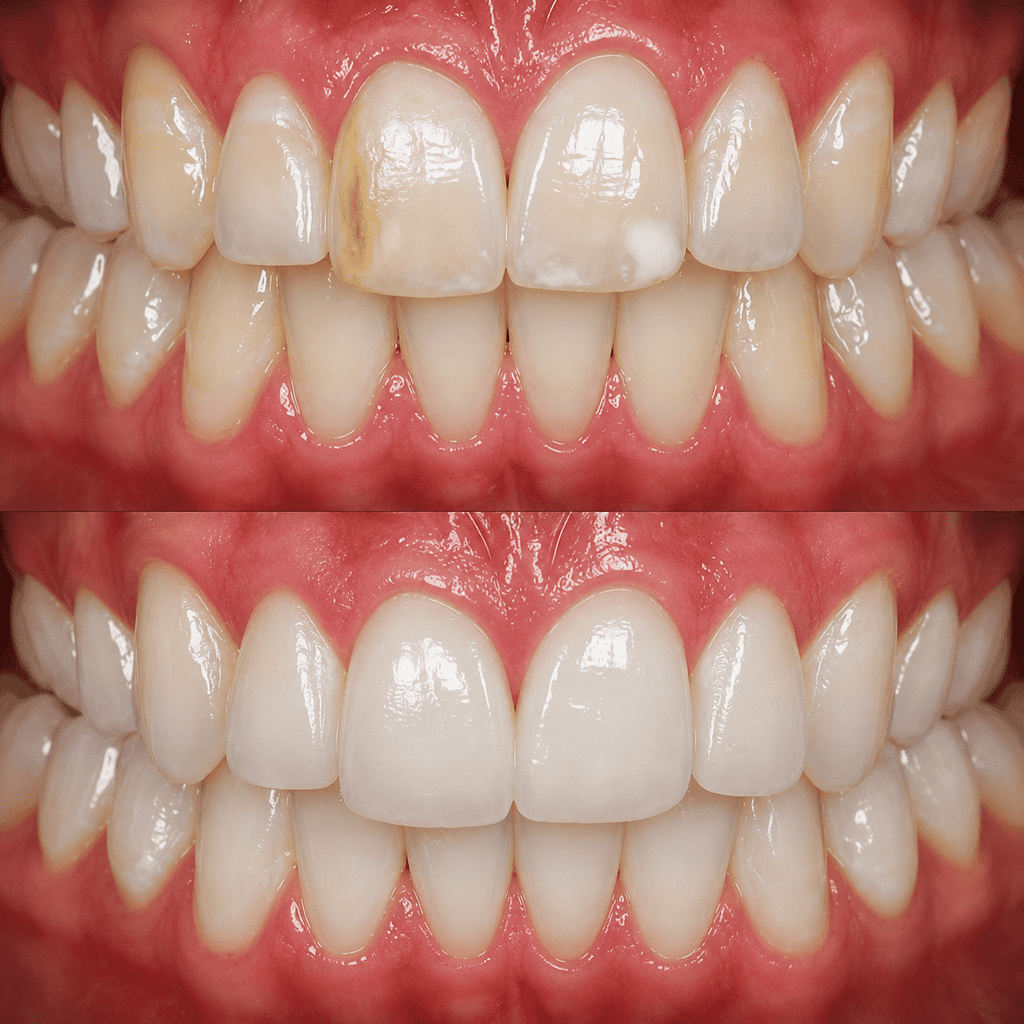
Our ICON White Spot Treatment uses a low-viscosity resin to infiltrate suitable porous enamel. By changing how light travels through the affected tissue, the material can make a pale patch blend more closely with the neighboring tooth.
This approach aims to preserve natural tooth structure because conventional drilling is generally unnecessary. Nevertheless, a very deep or unusual enamel defect may remain visible, even after carefully performed treatment.
What Happens During the Procedure?
After assessing the enamel, the dentist isolates and conditions the tooth surface. The liquid resin is applied, allowed to penetrate, cured with light, and finished to create a smooth surface.
The steps are relatively conservative, and local anesthesia is usually unnecessary. The final cosmetic response depends on the lesion’s depth, origin, and response to preparation.
What Does Professional Whitening Actually Change?
Professional teeth whitening uses bleaching agents to lighten natural tooth color. It can help with discoloration related to aging and certain food, drink, or tobacco stains, provided the teeth and gums are suitable for treatment.
Whitening acts more broadly than ICON, so it is not designed to repair the porosity associated with white spots. Sometimes the normal enamel lightens while the pale patches remain, leaving the contrast unchanged or temporarily more obvious.
For a wider discussion of discoloration options, read our earlier guide to teeth whitening vs veneers for stained teeth. That article explains when overall bleaching is useful and when discoloration may require another cosmetic approach.
ICON Treatment vs Teeth Whitening: The Practical Differences
| Question | ICON Treatment | Professional Whitening |
| Main objective | Mask suitable white enamel spots | Lighten natural tooth shade |
| How it works | Resin enters porous enamel | Bleaching agents change tooth pigments |
| Best target | Localized white lesions | Broader yellowing or discoloration |
| Tooth preparation | Usually no drilling | Usually no drilling |
| Main limitation | Deep lesions may remain visible | White spots may persist |
| Maintenance | Monitor treated enamel and oral health | Staining and shade changes may recur |
The treatments address different optical problems and cannot be interchanged. Choosing a procedure by name can disappoint when the underlying diagnosis is different.
Which Treatment Is Better for White Spots After Braces?
White spots following orthodontic treatment often involve mineral changes where plaque collected around brackets. For suitable non-cavitated lesions, resin infiltration can improve appearance more directly than whitening because it targets those porous areas.
Before cosmetic treatment, we check whether a white spot is stable, actively losing minerals, or already cavitated. Improved plaque control, fluoride-based prevention, and monitoring may be needed first; ICON is not a substitute for treating active decay.
Can ICON and Whitening Be Combined?
Some patients have yellowish natural teeth and isolated white patches at the same time. In those cases, whitening and ICON may form part of one treatment plan, but the sequence needs professional guidance.
Bleaching can change the overall tooth shade and temporarily affect the environment for resin-based procedures. The dentist may therefore recommend completing whitening first, allowing the shade to stabilize, and then evaluating whether infiltration is still needed.
There is no universal treatment order for every enamel condition. Our cosmetic dentistry team can assess both concerns before discussing a reasonable plan.
When Should You Consider Another Treatment?
Not every opaque patch is suitable for ICON or bleaching. Deep developmental defects, pitted enamel, structural damage, or a darkened tooth may require an alternative treatment that addresses the real problem.
Depending on the diagnosis, options can include:
- Professional cleaning for removable surface stains.
- Fluoride-based preventive treatment for certain early enamel lesions.
- Microabrasion for selected superficial enamel discoloration.
- Composite bonding to disguise certain defects and refine tooth shape.
- Dental veneers when a more extensive aesthetic change is justified.
These treatments involve different degrees of intervention, and their suitability cannot be determined from photographs alone. Our related article on veneers or crowns for a smile makeover explains why more extensive restorations should serve a genuine clinical purpose.
How Do You Keep Your Enamel Looking Healthy?
Good daily care matters whichever cosmetic treatment you choose. Brush twice daily with fluoride toothpaste, clean between your teeth, and attend dental appointments to monitor enamel and gum health.
Limit frequent exposure to sugary drinks and snacks, especially if white areas developed around orthodontic brackets. Whitening results can gradually change with staining habits, while resin-treated areas may also change appearance over time.
Avoid repeatedly using strong home bleaching products to chase the disappearance of an isolated white patch. If you notice sensitivity, roughness, or a growing lesion, seek an examination rather than assuming it needs more cosmetic treatment.
Frequently Asked Questions
Does ICON Require Drilling or Injections?
ICON treatment usually avoids conventional drilling and local anesthesia. Some patients may experience brief sensitivity during surface preparation, depending on their enamel condition.
Will ICON Make Every White Spot Disappear?
No treatment can guarantee that every defect becomes invisible. The degree of improvement depends on the depth and structure of the white area.
Can Whitening Make White Spots Worse?
Whitening can temporarily increase their contrast or visibility, particularly immediately after treatment. The appearance may change as the teeth rehydrate, so the result should be assessed after an appropriate interval.
Can White Spots Become Cavities?
Some white lesions represent early demineralization and can progress if the causes remain uncontrolled. Others are stable developmental marks, which is why diagnosis matters before choosing cosmetic care.
Is ICON Suitable for Adults?
Adults can be candidates when the enamel defect is appropriate for resin infiltration. Age alone does not establish suitability; a dentist must examine the lesion and surrounding tooth structure.
✨ White Spots After Braces? Ask About ICON and Whitening
If white spots became noticeable after orthodontic treatment, our dentists can assess their cause and explain whether resin infiltration, whitening, or preventive care is appropriate. Ask American Dental Hospital for a personalized, enamel-conscious plan.
- 📧 Email: dental@spitaliamerikan.com
- 📞 Phone: +355 68 808 0805
- 📍 Location: Rruga Sabaudin Gabrani Nr. 2, Tirana, Albania
- 🌐 Contact: Request a Cosmetic Dental Consultation
Get Your Free Dental Quote
Speak with an experienced dentist in Albania and receive a personalized treatment recommendation. We offer free evaluations for all dental treatments, with transparent pricing and expert guidance at every step.
Start your transformation today!
Send your details for a FREE CONSULTATION!
Blogs & Articles
Latest Articles
Get expert dental care tips and clinic updates—all designed to keep your smile healthy and bright.
Dental Treatment Plan in Albania: 8 Best Proven Steps
A dental treatment plan in Albania should explain the goals of your care, which appointments
Read More
Zirconia vs E-Max Crowns: 7 Essential Tips for a Better Smile
Zirconia vs E-Max crowns in Albania is an important comparison when choosing a ceramic restoration
Read More
All-on-6 vs All-on-8 in Albania: 7 Critical Differences
All-on-6 vs All-on-8 in Albania is an important comparison for patients considering fixed full-arch dental
Read More
Simple 1 minute consultation request for our experts
Request Your Free Quote
Start your transformation today!
Send your details for a FREE CONSULTATION!